
AP Government Unit 1 Study Guide: Foundations of American Democracy
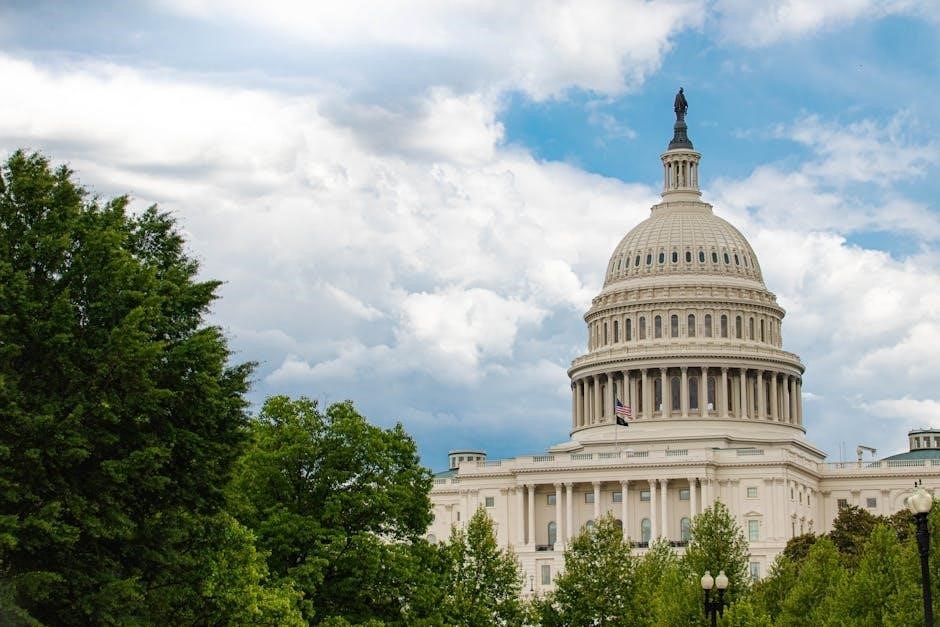
This guide explores the core tenets of US government, from democratic ideals and types to the Constitution’s framework, federalism, and the balance of power between branches.
1.1 Ideals of Democracy
The foundation of American democracy rests upon several core ideals, deeply influencing its political landscape. Central to these is the concept of political participation, encouraging citizens to engage actively in the governing process. This engagement manifests through voting, advocacy, and running for office, ensuring a responsive government.
Furthermore, equality and liberty are paramount, though often debated in their application. Equality strives for equal opportunity and treatment under the law, while liberty emphasizes individual freedoms. Balancing these ideals with majority rule and the protection of minority rights is a constant challenge. A functioning democracy necessitates respecting the rights of all, even when they differ from the majority’s views.
These ideals, stemming from Enlightenment thought, shape the expectations citizens have of their government and the principles guiding its actions. Understanding these core values is crucial for analyzing the American political system.
1.1.1 Core Democratic Values
At the heart of American democracy lie fundamental values that shape its political culture. These include a belief in individual rights – life, liberty, and the pursuit of happiness – alongside a commitment to popular sovereignty, where political power resides in the people. Furthermore, the rule of law ensures everyone, including government officials, is subject to and accountable under the law.
Civic engagement is also a core value, fostering a sense of responsibility among citizens to participate in their government. Transparency and accountability are vital, demanding openness from government and responsiveness to the electorate. These values aren’t merely abstract concepts; they are actively debated and contested in the political arena.
Understanding these core values provides a framework for evaluating the effectiveness and legitimacy of the American political system and its institutions.
1.1.2 Equality & Liberty
Equality and liberty represent foundational, yet often competing, ideals within American democracy. Liberty, encompassing freedoms of speech, religion, and assembly, emphasizes individual autonomy and protection from government interference. However, the scope of these liberties is continually debated and defined through legal interpretation.
Equality, in its various forms – political, social, and economic – strives for fairness and equal opportunity for all citizens. Political equality focuses on equal access to the political process, like voting rights. Social equality aims to eliminate discrimination, while economic equality addresses disparities in wealth and income.
Historically, the pursuit of equality has been a central theme in American history, driving movements for civil rights and social justice. The tension between individual liberty and collective equality remains a defining characteristic of American political thought and policy.
1.1.3 Majority Rule & Minority Rights
A cornerstone of American democracy is the principle of majority rule, where decisions are made based on the preference of the greater number. This ensures that the government reflects the will of the people, fostering legitimacy and responsiveness. However, unchecked majority rule can lead to the oppression of minority groups and the erosion of fundamental rights.
Therefore, the protection of minority rights is equally crucial. Constitutional safeguards, such as the Bill of Rights, are designed to shield individuals and groups from the potential tyranny of the majority. These rights are not absolute, but they establish limits on governmental power and ensure fair treatment for all.
Balancing majority rule with minority rights is a constant challenge, requiring ongoing vigilance and a commitment to upholding the principles of justice and equality for every citizen.
1.1.4 Political Participation
Active political participation is fundamental to a healthy democracy, enabling citizens to shape their government and hold leaders accountable. This participation takes many forms, extending beyond simply voting in elections. It includes activities like contacting elected officials, joining political parties, participating in protests and demonstrations, and engaging in public discourse.
Various factors influence levels of political participation, including socioeconomic status, education, age, and civic engagement. Lower participation rates can lead to unequal representation and policies that do not reflect the needs of all citizens.
Efforts to increase participation, such as voter registration drives and campaign finance reforms, aim to create a more inclusive and representative political system. A well-informed and actively engaged citizenry is essential for preserving democratic values and ensuring responsive governance.

1.2 Types of Democracy
Democracy manifests in various forms, including direct, representative (republic), constitutional, elite, and pluralist models, each differing in power distribution and citizen involvement.
1.2.1 Direct Democracy
Direct democracy embodies a system where citizens participate directly in decision-making processes, rather than electing representatives to act on their behalf. This model, historically practiced in ancient Athens and some New England town meetings, allows for immediate expression of the popular will on policy issues.
However, practical limitations hinder its widespread implementation in larger, more complex societies. Gathering all citizens for every decision proves logistically challenging and time-consuming. Furthermore, direct democracy can be susceptible to the “tyranny of the majority,” potentially overlooking the rights and interests of minority groups.
While pure direct democracy is rare at the national level today, elements of it persist through mechanisms like initiatives and referendums, allowing citizens to directly vote on specific laws or constitutional amendments. These tools offer a degree of direct citizen control within a representative framework, bridging the gap between pure representation and direct participation.
1.2.2 Representative Democracy (Republic)
Representative democracy, often termed a republic, is a system where citizens elect individuals to represent their interests and make decisions on their behalf. This contrasts with direct democracy, where citizens vote on policies directly. The United States operates as a representative democracy, with elected officials at local, state, and federal levels.
This system offers practical advantages for larger populations, allowing for efficient governance and specialized expertise in policymaking. Representatives are expected to be informed about complex issues and deliberate on behalf of their constituents. However, it also introduces the potential for representatives to prioritize their own interests or those of specific groups over the broader public good.
A key feature of a republic is the emphasis on the rule of law and the protection of individual rights through a constitution. This framework aims to prevent the abuse of power and ensure accountability of elected officials to the citizenry.
1.2.3 Constitutional Democracy
Constitutional democracy blends representative democracy with the rule of law enshrined in a constitution. This means elected representatives operate within a framework of established legal principles and limitations on governmental power. The US exemplifies this, with the Constitution serving as the supreme law of the land.
A constitution defines the structure of government, outlines the rights of citizens, and establishes procedures for making and enforcing laws. It safeguards against tyranny by distributing power and protecting fundamental freedoms like speech, religion, and assembly. Constitutional democracies prioritize minority rights, ensuring they aren’t suppressed by majority rule.
Judicial review, the power of courts to declare laws unconstitutional, is a crucial component. This ensures laws align with constitutional principles. While representative, a constitutional democracy isn’t solely based on popular opinion; it’s grounded in enduring legal principles.
1.2.4 Elite vs. Pluralist Democracy
Elite democracy posits that a small, knowledgeable group – often societal leaders or experts – should govern, believing they are best equipped to make decisions. This contrasts with pluralist democracy, which argues that power is distributed among various competing interest groups.
In pluralism, these groups (businesses, unions, advocacy organizations) influence policy through lobbying, campaigning, and public pressure. No single group dominates; instead, decisions result from bargaining and compromise. This model assumes citizens are reasonably informed and actively participate through these groups.
Critics of elite democracy argue it’s undemocratic and susceptible to serving the interests of the few. Conversely, pluralism faces criticism for potentially leading to gridlock or favoring well-funded interests. The US system exhibits elements of both, with elected officials navigating diverse group pressures while relying on expert advice.

1.3 The Declaration of Independence
This document articulates key principles like natural rights and popular sovereignty, listing grievances against British rule and profoundly influencing American political thought.
1.3.1 Key Principles & Grievances
The Declaration of Independence rests upon several core principles, most notably the concept of natural rights – rights inherent to all individuals, not granted by governments. These include life, liberty, and the pursuit of happiness, echoing John Locke’s philosophies. Popular sovereignty, the idea that governmental power resides in the people, is also central. The document asserts the right of the people to alter or abolish a government that becomes destructive of these ends.
However, the Declaration isn’t merely a statement of ideals; it’s a detailed list of grievances against King George III and the British government. These complaints range from imposing taxes without colonial consent (“no taxation without representation”) to quartering troops in colonial homes and obstructing the administration of justice. The document meticulously outlines acts perceived as tyrannical, justifying the colonies’ decision to separate and establish self-governance. These grievances served as a powerful indictment of British rule and a rallying cry for independence.
1.3.2 Natural Rights Philosophy
The concept of natural rights, profoundly influencing the Declaration of Independence, originates with Enlightenment thinkers like John Locke. Locke argued that individuals possess inherent rights – life, liberty, and property – existing prior to government. These rights aren’t bestowed by rulers; they are intrinsic to human existence. Thomas Jefferson famously adapted Locke’s “property” to “the pursuit of happiness,” reflecting a broader American ideal.
This philosophy posits that government’s primary purpose is to protect these natural rights, not to infringe upon them. If a government fails to uphold this duty, the people have the right to alter or abolish it. The Declaration explicitly invokes this justification for revolution, asserting that governments derive their just powers from the consent of the governed. This idea fundamentally challenged the traditional notion of divine right of kings, establishing a new basis for legitimate political authority rooted in individual liberty and popular sovereignty. It remains a cornerstone of American political thought.

1.3.3 Influence on American Political Thought

The Declaration of Independence’s articulation of natural rights and popular sovereignty deeply permeated American political thought, shaping subsequent movements and debates. It provided a moral and philosophical foundation for the American Revolution, justifying the colonists’ separation from British rule. The emphasis on individual liberty became a central tenet of American identity, influencing the Bill of Rights and ongoing struggles for civil rights and equality.
Furthermore, the Declaration’s principles fueled debates about the scope of government power and the balance between individual freedom and collective well-being. The idea of “consent of the governed” continues to inform discussions about democratic participation and accountability. It inspired abolitionists, suffragists, and civil rights activists, who invoked its ideals to challenge existing injustices. The document’s enduring legacy lies in its capacity to serve as a touchstone for evaluating American progress and striving towards a more perfect union, constantly reinterpreted through evolving societal values.
1.4 The Constitution & Federalism
This section examines the shift from the Articles of Confederation to the Constitution, exploring federalism—the division of power—and governmental structures.
1.4.1 Articles of Confederation: Weaknesses
The Articles of Confederation, adopted in 1777, represented the first attempt to establish a national government after independence from Britain. However, it quickly revealed significant weaknesses that threatened the newly formed nation’s stability. A primary flaw was its creation of a largely powerless central government, intentionally designed to avoid replicating the strong authority of the British monarchy.
Crucially, the central government lacked the ability to effectively tax, relying instead on voluntary contributions from the states – which were often insufficient. This financial constraint hindered its capacity to pay debts incurred during the Revolutionary War and maintain a national defense. Furthermore, the Articles lacked a national currency, complicating interstate trade and economic growth.
The absence of a strong executive branch and a national judiciary further hampered effective governance. Congress, the sole branch, struggled to enforce laws and resolve disputes between states. Amendments to the Articles required unanimous consent from all thirteen states, making necessary changes virtually impossible. Shays’ Rebellion, an uprising of indebted farmers in Massachusetts, vividly demonstrated the central government’s inability to maintain order and underscored the urgent need for a stronger national framework;
1.4.2 Constitutional Convention & Compromises
Recognizing the inadequacies of the Articles of Confederation, delegates from twelve of the thirteen states (Rhode Island abstained) convened in Philadelphia in 1787 to revise them; However, it quickly became apparent that a complete overhaul was necessary, leading to the drafting of a new Constitution.
The Convention was marked by intense debates and compromises, most notably concerning representation in the legislature. The Virginia Plan favored large states with representation based on population, while the New Jersey Plan advocated for equal representation for all states. The Great Compromise (Connecticut Compromise) resolved this impasse by establishing a bicameral legislature: the House of Representatives, based on population, and the Senate, with equal representation.
Another contentious issue was slavery. The Three-Fifths Compromise determined that three-fifths of the enslaved population would be counted for both representation and taxation purposes. The Constitution also included a provision delaying the prohibition of the transatlantic slave trade until 1808. These compromises, while enabling the creation of the Constitution, also embedded inherent contradictions that would later contribute to national conflict.
1.4.3 Federal vs. Unitary vs. Confederate Systems
Understanding governmental structures is crucial. A unitary system concentrates power in a central government, which may delegate authority but ultimately retains supreme control – think of most European nations. Conversely, a confederate system, like the Articles of Confederation, features independent states with limited central authority, prioritizing state sovereignty.

The United States adopted a federal system, a hybrid approach dividing power between a national government and state governments. This division is enshrined in the Constitution, with specific powers delegated to the federal government and others reserved for the states. This system aims to balance national unity with regional autonomy.
Federalism isn’t static; the balance of power has shifted over time through constitutional amendments and judicial interpretations. Debates over states’ rights versus federal authority continue to shape American politics. The US system avoids the pitfalls of both overly centralized control and fragmented disunity, though tensions remain inherent in its design.
1.4.4 Powers of the Federal Government (Enumerated, Implied, Reserved)
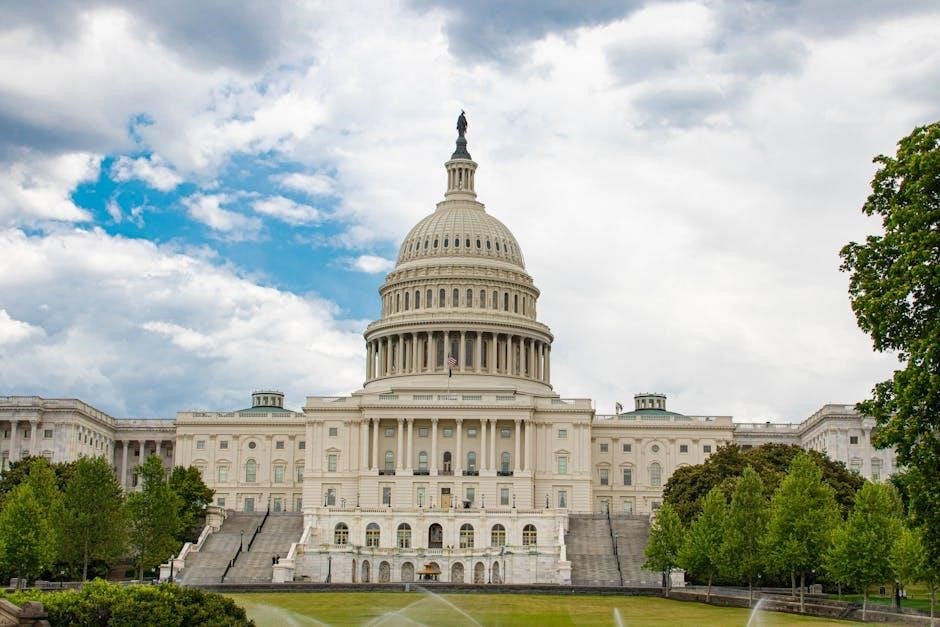
The Constitution meticulously defines the federal government’s powers. Enumerated powers, explicitly listed in Article I, Section 8, include things like declaring war, regulating interstate commerce, and coining money. These are direct grants of authority.
However, the Necessary and Proper Clause (also known as the Elastic Clause) grants Congress implied powers – those reasonably deduced from the enumerated powers. This allows the government to adapt to changing circumstances, though it’s often a source of debate regarding the scope of federal authority.
Finally, the Tenth Amendment reserves powers not delegated to the federal government, nor prohibited to the states, to the states respectively, or to the people. These reserved powers encompass areas like education, local government, and intrastate commerce. Understanding this division is key to grasping the dynamics of federalism and ongoing legal battles over governmental authority.

1.5 Separation of Powers & Checks and Balances
The Constitution divides governmental authority among three branches—legislative, executive, and judicial—each with distinct powers, ensuring no single entity becomes dominant.
1.5.1 Legislative Branch Powers
The Legislative Branch, embodied by Congress (the House of Representatives and the Senate), holds the primary responsibility for creating laws. This power is explicitly outlined in Article I of the Constitution. Key powers include the ability to declare war, coin money, and regulate commerce. Congress also possesses the “power of the purse,” controlling federal spending and taxation.
Furthermore, the Senate uniquely confirms presidential appointments (like judges) and ratifies treaties. Impeachment power, initiating in the House and tried by the Senate, serves as a crucial check on both the executive and judicial branches. Midterm elections can significantly shift the balance of power, acting as a check on the executive branch. Legislative oversight, through hearings and investigations, ensures accountability within the executive branch. These powers, collectively, define Congress’s central role in shaping national policy and overseeing the other branches of government.
1.5.2 Executive Branch Powers
The Executive Branch, headed by the President, is responsible for enforcing laws passed by Congress. Article II of the Constitution details these powers, including serving as Commander-in-Chief of the armed forces, negotiating treaties (subject to Senate ratification), and appointing federal judges and officials (with Senate confirmation). The President can also veto legislation passed by Congress, though Congress can override a veto with a two-thirds vote in both houses.
Executive orders allow the President to manage operations of the federal government. The power to grant pardons and reprieves for federal offenses is another significant authority. While not explicitly stated in the Constitution, the President’s role as chief diplomat and agenda-setter has expanded over time. Importantly, the President isn’t dependent on the other branches for election or continuance in office, maintaining a degree of political independence.
1.5.3 Judicial Branch Powers & Judicial Review
The Judicial Branch, established by Article III of the Constitution, interprets laws and ensures their constitutionality. Its primary power is judicial review – the ability to declare executive and congressional actions unconstitutional. This power, though not explicitly mentioned in the Constitution’s ideals, was established in Marbury v. Madison (1803). Federal courts have jurisdiction over cases involving federal law, disputes between states, and cases involving the U.S. government.
Judges, appointed by the President and confirmed by the Senate, serve life terms, ensuring independence from political pressures. The Supreme Court is the highest court in the land, and its decisions are binding on all lower courts. The judicial branch’s power to interpret laws significantly shapes policy and impacts American society, acting as a crucial check on the other branches of government.